


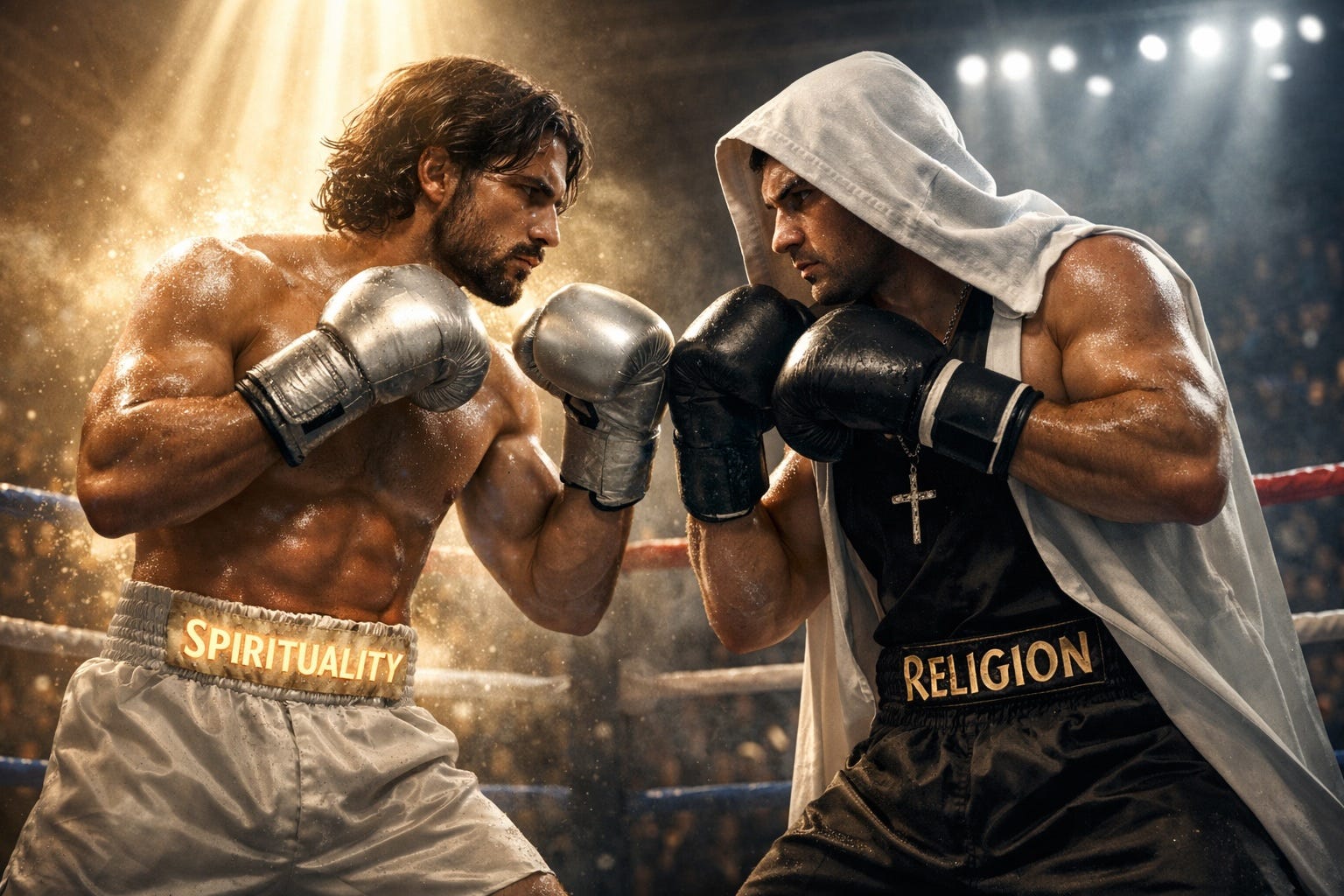
There are certain words that, over time, begin to carry more weight than meaning.
Not because they are inherently flawed—but because they have been redefined, misused, or misunderstood.
Today, “religion” is one of those words.
For some, it sounds rigid. Institutional. Restrictive.
For others, it conjures images of rules, obligations, and a loss of personal freedom.
And so, a quiet shift has taken place in our culture:
“I’m spiritual… but not religious.”
At first glance, that sounds thoughtful—even sincere. But if we pause and look more closely, we begin to notice something deeper happening beneath the surface.
We have not simply redefined religion.
We have, in many ways, rejected it.
When a Word Becomes a Warning Sign
In our time, certain words are treated almost as if they need to be avoided or rebranded.
Words like “discipline,” “authority,” or even “truth” can feel uncomfortable.
They sound limiting in a culture that values personal expression above almost everything else.
“Religion” has fallen into that same category.
It is sometimes spoken of the way one might speak about outdated methods or restrictive systems—something humanity has outgrown.
But this raises an important question:
What if the problem is not religion itself… but our understanding of it?
Religion Is Not the Enemy of Spirituality
At its heart, the Christian life is deeply spiritual.
It is about encountering God.
Not as an abstract idea—but as a living Person.
It is about grace.
Transformation.
Relationship.
But here is where we must be careful:
Spirituality without structure can become directionless.
If spirituality is simply “whatever it means to me,” then it slowly loses its ability to guide, to challenge, or to transform. It becomes shaped more by preference than by truth.
And while that may feel freeing at first… it often leaves us wandering.
Because deep down, the human heart is not just searching for experience.
It is searching for meaning.
And meaning requires something solid.
A Home for the Soul
This is where religion comes in—not as a limitation, but as a gift.
If spirituality is the fire, then religion is the hearth that holds it.
If spirituality is a seed, religion is the soil that allows it to take root.
Without a place to live, grow, and be nourished, even the most sincere spirituality can fade, distort, or become something entirely self-referential.
The Catholic faith, in particular, offers something profoundly beautiful:
Not just ideas about God…
But encounter with Him.
In the sacraments.
In the liturgy.
In the life of the Church.
This is not about control.
It is about communion.
Freedom Through Form
There is a paradox at the heart of the Christian life:
True freedom is not found in the absence of structure…
but in the right kind of structure.
A musician becomes free through discipline.
An athlete becomes free through training.
A pilot becomes free through understanding the laws of flight.
In the same way, the soul becomes free when it lives within the truth of what it was created for.
Religion, rightly understood, does not restrict us.
It orients us.
It keeps us from drifting into a spirituality that is shaped only by feelings, trends, or convenience.
It invites us into something deeper.
Something tested.
Something true.
More Than Rules—A Living Relationship
One of the greatest misunderstandings about Catholicism is that it is primarily about rules.
But rules, in their proper place, are not the destination.
They are the guardrails.
They exist to protect something sacred.
At the center of the Catholic faith is not a rulebook.
It is a Person.
Jesus Christ.
And religion, in its truest sense, is the way we respond to Him—not just privately, but communally, sacramentally, and faithfully over time.
It gives shape to love.
It gives rhythm to prayer.
It gives depth to belief.
Why This Matters Today
We are living in a time where meaning is often personalized to the point of fragmentation.
Truth becomes subjective.
Morality becomes negotiable.
Spirituality becomes self-defined.
And while this may appear compassionate or open-minded, it can also leave people unanchored—searching, but never quite finding.
The Catholic faith does something radically different.
It says:
There is truth.
There is meaning.
There is a way.
Not imposed from the outside…
but revealed by a God who loves us enough to show us how to live.
A Gentle Invitation
Perhaps the question is not:
“Are you spiritual or religious?”
But something deeper:
What kind of spirituality are you living?
And…
where does it lead you?
Because a spirituality without a home can only go so far.
But a spirituality rooted in truth…
nourished by grace…
and lived within the life of the Church…
can become something extraordinary.
Not restrictive.
But transformative.
Not distant.
But deeply personal.
Not merely human.
But supernatural.
Closing Reflection
Religion is not a bad word.
It is not something we outgrow.
It is something we rediscover—properly understood—as a path.
A path that does not limit our encounter with God…
but makes it possible.
And not just possible.
But real.
If this reflection stirred something in your heart, I invite you to continue the journey in a different way. Visit Harbor Close Travel, where travel is designed not just to take you somewhere—but to deepen your sense of wonder, peace, and purpose. It’s a natural extension of this path… one that allows you to experience beauty, meaning, and renewal in the world around you.
I like to think of religion as the scientific application of spiritual principles stemming from divine revelation especially Jesus of Nazareth, our Lord and our God, second person of the Blessed Trinity, and guided, as promised, by The Paraclete, leading to eternal life with the Father, Son, and Holy Spirit.