


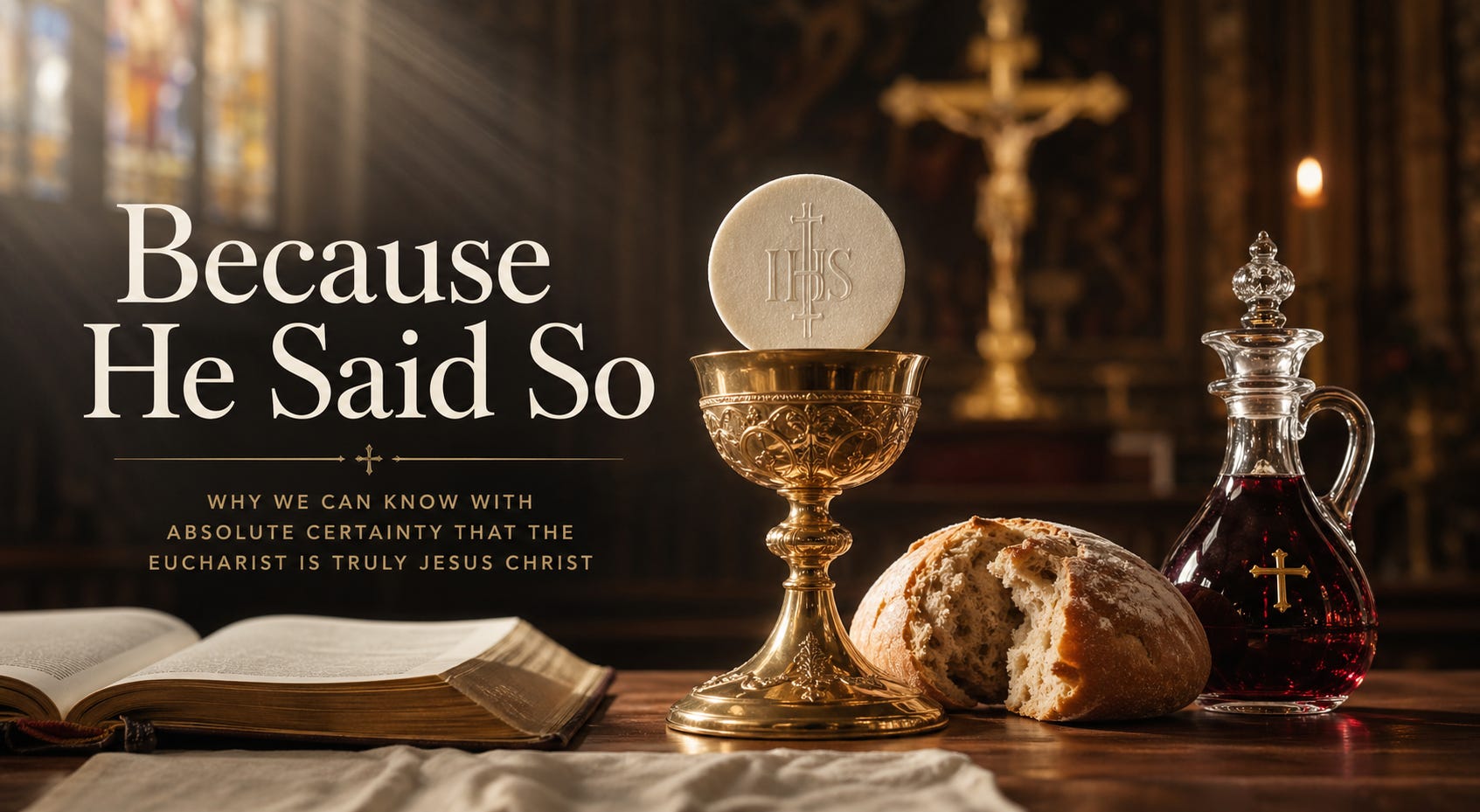
Why we can know with certainty that the Eucharist is truly Jesus Christ
There are moments in life when explanation gives way to authority. Not the kind that dominates, but the kind that loves, protects, and knows more than we do.
As a young boy, I remember asking questions the way children do.
“But why?”
Why can’t I stay up late?
Why can’t I ride my bike into town?
Why do I have to share my toys?
And after a certain number of explanations, patient ones at first and then shorter ones, my mother would eventually say something that ended the conversation:
“Because I said so.”
It was not a dismissal. It was a boundary rooted in trust. At some point, I had to decide whether I believed that my mother knew what was good for me—even when I did not understand it.
Years later, standing in a church and hearing the words of consecration, “This is my body… this is my blood,” those same words echo again.
Because He said so.
Not a Symbol, but a Statement
When Jesus spoke about the Eucharist, He did not speak in vague metaphors or poetic abstractions. He spoke with clarity—and with insistence.
In the Gospel of John, chapter 6, He says:
“I am the living bread which came down from heaven; if any one eats of this bread, he will live for ever; and the bread which I shall give for the life of the world is my flesh.” (Jn 6:51)
The crowd reacts the way we might expect:
“How can this man give us his flesh to eat?” (Jn 6:52)
And here is the moment everything hinges on.
Jesus does not correct them.
He does not soften His language.
He does not say, “Wait, you misunderstood. I meant this symbolically.”
Instead, He speaks even more plainly—more directly:
“Truly, truly, I say to you, unless you eat the flesh of the Son of man and drink his blood, you have no life in you.” (Jn 6:53)
And then:
“My flesh is food indeed, and my blood is drink indeed.” (Jn 6:55)
This was so difficult to accept that many of His disciples walked away:
“After this many of his disciples drew back and no longer went about with him.” (Jn 6:66)
If ever there were a moment for Jesus to clarify a misunderstanding, this was it.
He let them go.
The Last Supper: No Metaphor, Only Declaration
Fast forward to the night before His Passion.
At the Last Supper, Jesus takes bread, blesses it, breaks it, and says:
“This is my body which is given for you.” (cf. Lk 22:19)
Then the cup:
“This cup which is poured out for you is the new covenant in my blood.” (cf. Lk 22:20)
He does not say, “This represents my body.”
He does not say, “This is like my body.”
He says: This is.
And the apostles—those who had already wrestled with His words in John 6—receive it.
The Witness of the Early Church
This understanding did not develop centuries later. It was there from the beginning.
In the First Epistle to the Corinthians, St. Paul writes:
“Whoever, therefore, eats the bread or drinks the cup of the Lord in an unworthy manner will be guilty of profaning the body and blood of the Lord.” (1 Cor 11:27)
You cannot profane a symbol.
You can only profane something real.
Transubstantiation and Trust
The Church gives us the word transubstantiation to describe this mystery. The substance of bread and wine becomes the Body and Blood of Christ, while the appearances remain.
It is a precise and beautiful explanation.
But even before we grasp the philosophy, we are invited into something more fundamental.
Trust.
Not blind trust. Not irrational belief.
Trust in a Person.
The same Jesus who calmed storms.
The same Jesus who raised the dead.
The same Jesus who forgave sins and conquered the grave.
When He says, “This is my body,” we are faced with a decision.
Do we believe Him—or do we walk away?
A Child’s Faith, A Disciple’s Decision
There is something profoundly mature hidden inside what looks like a child’s answer.
“Because He said so.”
Not because we stopped thinking.
But because we followed the thinking all the way to its end—and found a Person we trust more than ourselves.
In John 6, after many walked away, Jesus turns to the Twelve and asks:
“Will you also go away?” (Jn 6:67)
And Saint Peter responds:
“Lord, to whom shall we go? You have the words of eternal life.” (Jn 6:68)
That is it.
Not a philosophical treatise.
Not a theological dissertation.
Just trust.
Because He Said So
The Eucharist is not something we reduce to understanding.
It is something we receive in faith.
And sometimes, faith sounds like the voice of a loving parent—or the quiet echo of childhood:
Because He said so.
And that is enough.
I hope you’re enjoying our articles here on Always Toward the Light. Your comments, reflections, reactions, and likes are always appreciated. They help us know that they are reaching people and making a difference. I encourage you to share these articles with others and visit our website at: https://alwaystowardthelight.org.

Below is a link to my Author’s page. I encourage you to browse the titles and consider if one of these books might make a great addition to your library or someone else’s.
Been thinking about a vacation to uplift your spirit?
Whether it’s a quiet beach, a walk through an old city, or simply time to breathe, the right journey has a way of restoring what matters most.
We make your vacation easy. You make it wonderful.
Visit me at Harbor Close Travel. I will help you escape the ordinary and look forward to memories that last a lifetime.
Amen!!